
On The Blog
One Circle, Many Dots: Cultivating Steadiness in a Distracted World
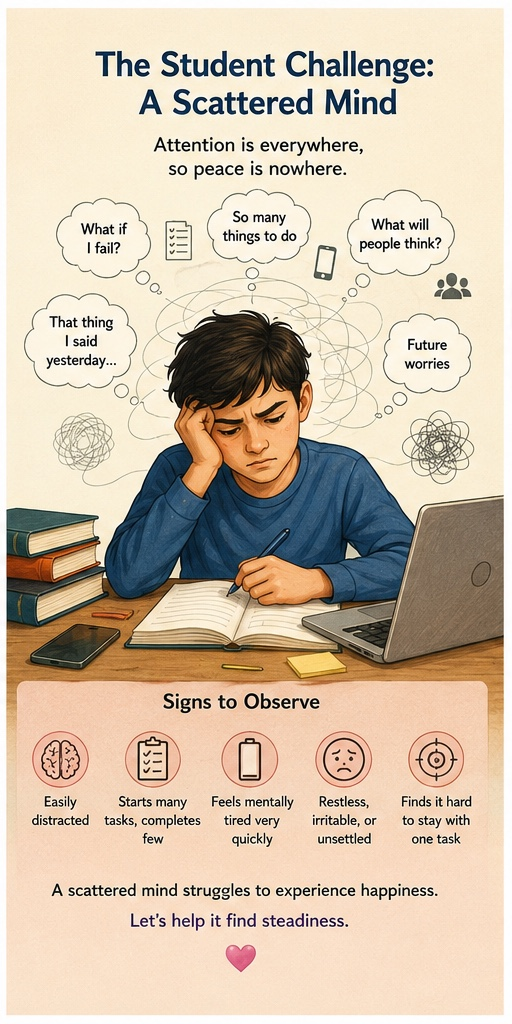
When we observe students today, one common challenge becomes visible. It is not merely academic pressure. It is not only social media. It is not simply a lack of concentration.
The deeper challenge is that a student's attention is constantly fragmented. Their mind moves rapidly from one stimulus to another—a notification, a conversation, an academic task, a memory, a worry, an expectation, or a comparison.
As a result, many students rarely experience mental stillness. They are physically present in the classroom but psychologically travelling between multiple thoughts, emotions, and experiences. This constant movement creates mental fatigue, emotional restlessness, and a reduced capacity to experience happiness.
A Vedantic Understanding
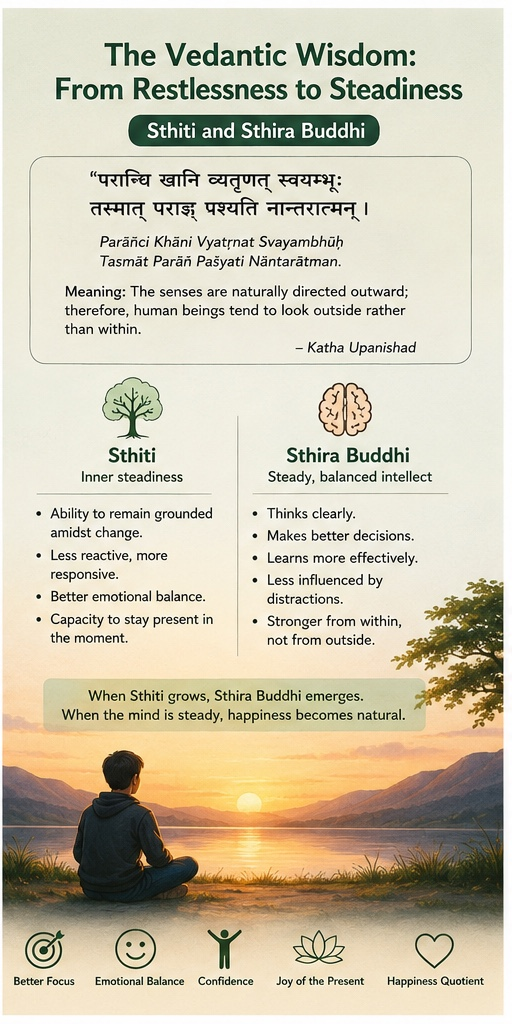
Thousands of years ago, the sages of the Upanishads observed this very tendency of the human mind. The Katha Upanishad states:
तस्मात् पराङ् पश्यति नान्तरात्मन्।"
This observation is highly relevant in today's educational environment. Students are constantly exposed to information, stimulation, expectations, and distractions. Their attention is repeatedly pulled outward, leaving very little opportunity to develop inner awareness.
Vedanta suggests that true education is not only the acquisition of knowledge but also the cultivation of inner stability. This quality is called Sthiti.
What is Sthiti?
Sthiti means steadiness, stability, and the ability to remain grounded amidst change. A student with Sthiti is not free from challenges. Rather, they are able to remain balanced while facing those challenges. When Sthiti develops, students become less reactive and more responsive:
- They learn to pause before acting.
- They become less influenced by external distractions.
- They recover more quickly from disappointment, criticism, or failure.
- Most importantly, they develop the capacity to remain present in the task at hand.
Without Sthiti, the mind becomes like a leaf blown by every passing wind. With Sthiti, the mind develops roots.
What is Sthira Buddhi?
When Sthiti becomes stronger, it begins influencing the intellect. This state is called Sthira Buddhi — a steady, balanced, and clear intellect. A student with Sthira Buddhi thinks more clearly, makes better decisions, learns more effectively, is less affected by peer pressure, experiences greater emotional balance, and develops confidence based on inner strength rather than external validation.
In Vedantic thought, Sthira Buddhi is considered one of the foundations of mature living because it allows a person to see situations clearly without being overwhelmed by emotions or distractions.
Why Sthiti & Sthira Buddhi Matter
Modern education often focuses on information. However, happiness depends upon the quality of attention. A restless mind may possess knowledge yet remain unhappy. A distracted mind may achieve success yet struggle to experience contentment. When students develop Sthiti and Sthira Buddhi:
- They experience less mental chaos.
- They become more emotionally resilient.
- They engage more deeply in learning.
- They enjoy activities more fully.
- They develop a stronger sense of self-awareness.
- They experience greater inner balance.
From a Vedantic perspective, happiness is not merely the result of favourable circumstances. Happiness emerges when the mind becomes steady enough to experience life fully.
The Practice
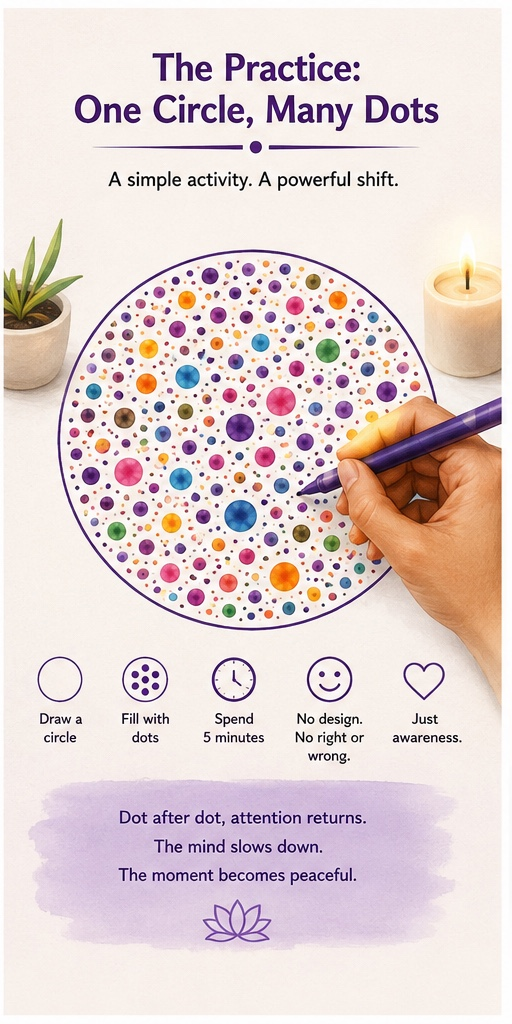
- Draw a circle.
- Spend five minutes filling it with dots (large, small, and coloured dots).
- Nothing else. No artistic skill is required.
- No competition exists. No perfect outcome is expected.
- Just a circle and dots.
Why Does It Matter?
At first glance, placing dots inside a circle appears insignificant. Yet something profound is happening beneath the surface. The student is repeatedly returning attention to a single action. Dot after dot. Moment after moment.
The activity does not demand complex thinking. It does not create performance anxiety. It does not ask the student to achieve anything. Instead, it offers a rare opportunity to simply remain present.
Connection with Happiness Quotient
A fragmented mind struggles to experience satisfaction. A restless mind finds it difficult to remain engaged. A distracted mind often misses the joy of the present moment. When students practice sustained attention through simple activities such as dot-making, they gradually develop attention stability, emotional regulation, patience, self-awareness, present-moment engagement, and mental calmness. These qualities directly contribute to a healthier Happiness Quotient.
Reflection
💭 How many different things are competing for my attention right now?
- 💭 Was I able to stay with one simple action for five minutes?
- 💭 Did my mind become quieter, slower, or more settled?
- 💭 How do I feel now compared to before?
Final Thought
Through a simple circle and a collection of dots, students begin practicing ancient Vedantic principles:
Sthiti — the steadiness to remain grounded.
Sthira Buddhi — the clarity to think wisely.
"Because a happy student is not the one who faces the fewest challenges. A happy student is the one who develops the inner stability to face life with awareness, balance, and confidence."